The Crystal Palace dinosaurs: Victorian sculptures in a London park
When the park opened in 1854, sculptures were unveiled that still attract researchers and enthusiasts of the history of science. The Crystal Palace dinosaurs are among the earliest life-size reconstructions of extinct animals ever shown to the public. Who made them, and what exactly do they depict? Why are these sculptures, despite their many inaccuracies, still considered valuable? This article explores their origins, what they represent and their lasting significance.
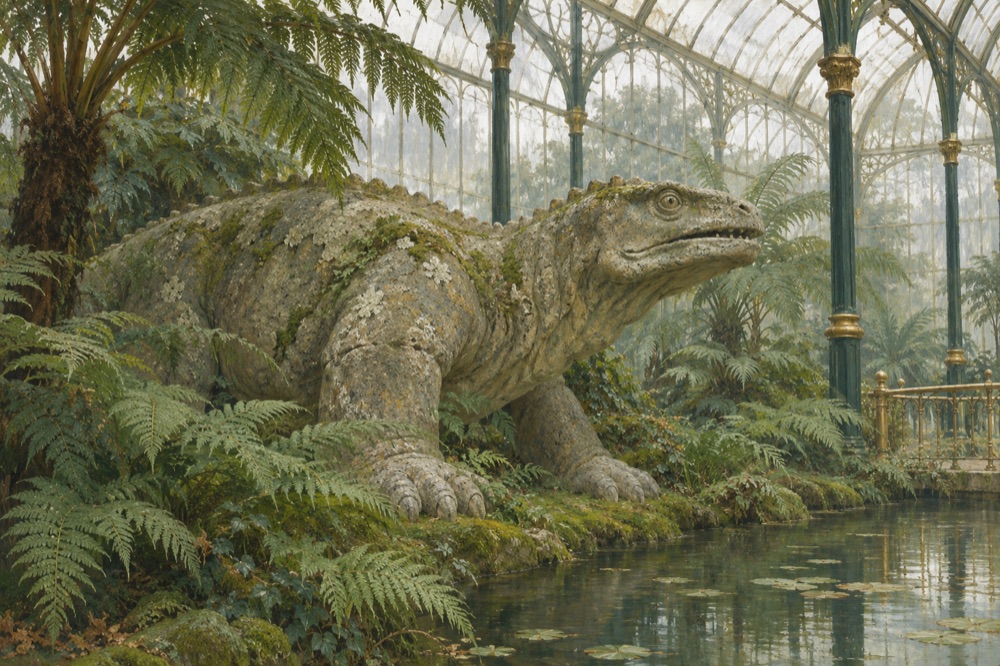
Who made the Crystal Palace dinosaurs?
The sculptures were made by Benjamin Waterhouse Hawkins, who worked under the direction of the anatomist Richard Owen. Their distinct roles are important: Hawkins was responsible for making the models, while Owen provided the scientific interpretation of how the extinct animals might have looked. Hawkins's team began work around 1852, about two years before the park opened.
For visitors at the time, the sculptures offered a completely new experience. Until then, extinct reptiles had been known mostly through drawings, descriptions and individual bones. Here, dinosaur sculptures stood in the open park, where anyone could see them up close. The collaboration between a sculptor and an anatomist shows that the project was intended from the outset to bring art and science together. This makes the Crystal Palace dinosaurs one of the more important examples of the popularisation of science in the nineteenth century.
What do the dinosaur sculptures show?
The four main models depict three kinds of animal: one Megalosaurus, one Hylaeosaurus and two Iguanodons. These sculptures form the core of the group and are the ones most often mentioned in descriptions of the park.
Each of these animals was then known from only a limited number of remains, so the sculptures relied heavily on interpretation. They are more than decorative features. The park is listed at grade II* on the Historic England register of historic parks and gardens, and the dinosaurs are an important part of it. That protection recognises the site's historical value, with the sculptures serving as more than a curiosity for visitors. In 2025, major restoration works began in the park, covering the dinosaurs and the terraces, among other features. The works are planned to continue until the autumn of 2026, reflecting the ongoing care these sculptures receive.
Why are the reconstructions imprecise, and yet valuable?
Researchers point out that some of the reconstructions were inaccurate. One reason was the scarcity of fossil bones, especially skulls. Without complete skeletons, those creating the models had to fill the gaps with assumptions that might later prove mistaken. The inaccuracies therefore cannot simply be attributed to the sculptor or the anatomist: they also reflect the limits of mid-nineteenth-century knowledge.
Palaeontology today presents these animals differently from how they were understood in 1854. Yet that difference is what makes the sculptures so valuable. The Crystal Palace dinosaurs record the state of science at a particular moment, along with the way people imagined the Earth's past. Comparing them with modern reconstructions reveals how research methods have changed.
First, the dinosaur sculptures remind us that science corrects its own findings. Second, they provide evidence of an early attempt to present extinct animals to the public at life size, beyond the pages of textbooks. Third, as monuments, they help us understand how scientific knowledge was popularised in the Victorian era. Errors in proportions or the shape of the skulls therefore do not diminish the significance of the undertaking as a whole.
The Victorian dinosaurs today
The sculptures made by Benjamin Waterhouse Hawkins under the supervision of Richard Owen have a dual significance. They are evidence of the first attempts to reconstruct extinct animals and, at the same time, a monument to the Victorian imagination. For anyone interested in the history of science, they offer a point of comparison with more recent palaeontological findings. The Crystal Palace dinosaurs are best understood not as a faithful picture of the past but as a valuable record of their own age. Before planning a visit, it is worth checking the latest news on the progress of restoration works in the park.